The Waymo Stopped
When machines notice us and humans don't.

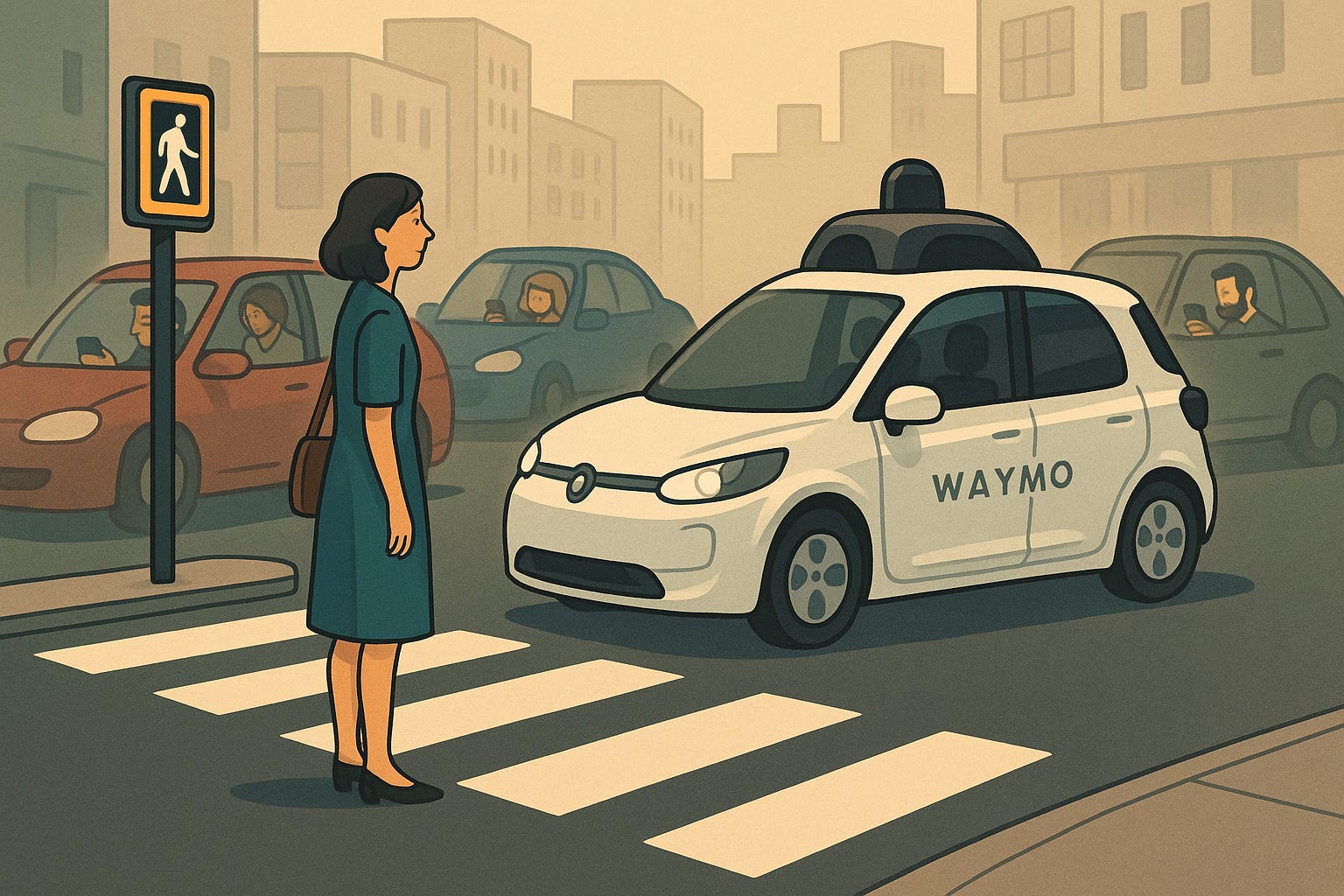
I was in Austin last week, where the future arrives quietly, not with spectacle or drama, but with the unsettling casualness of something that used to feel extraordinary. Waymos (the driverless cars with their rounded sensor domes and empty front seats) slide through the city as if they’ve always been there. A car glides through an intersection without a driver? Just another Tuesday.
And I’ll admit: I was excited like a kid in a candy store. I wanted to ride in one.
So I did.
I kept thinking: when will we have these in NYC? But of course, wider streets, less density, and newer infrastructure. For now, the future is being tested in easier cities.
The engineering is extraordinary. The ability to navigate complex traffic, read pedestrian movement, and make split-second decisions in real time. I sat in the back seat watching the steering wheel turn itself, the car gliding smoothly through intersections, and thought: this is astonishing.
While I was there, someone I work with who lives in Austin told me something that stayed with me. She’d been at a crosswalk a few times recently, and the cars didn’t stop.
She said it casually, as if she were recounting a minor inconvenience.
But then she added, almost as an afterthought: “But this week… the Waymo stopped.”
The way she said it (surprised, almost grateful) stayed with me for the rest of the day. There was something in her voice that didn’t match the surface of the story. Something softer. Something like relief. Recognition. Maybe even a slight disbelief.
Because this wasn’t really about traffic, it was about being seen.
We talk about AI as if the central threat is intrusion: surveillance, data capture, the erosion of privacy. But increasingly, the deeper psychological wound is something quieter: substitution. Machines are noticing us in the exact places where people have stopped seeing each other.
That moment stayed with me because it crystallized something I’ve been noticing everywhere.
I’ve been thinking a lot about compression. About how we’ve learned to shrink ourselves into a format that machines prefer. Say it quickly. Say it cleanly. Don’t take up space. Don’t require time.
I’m writing this on a bus right now, traveling through the Northeast, watching people contort themselves into positions that must hurt. Headphones in, shoulders curled, wrists bent at impossible angles as they scroll, type, and thumb-text their way through the ride. The bus window next to me rattles when we hit a bump, and the wind whistles through a thin gap in the frame. It’s a soft, almost nostalgic sound, like an old house settling, and I find myself drifting in and out of sleep to it.
And part of why I can still hear it (why I notice it at all) is that my early sensory life formed before phones became constant companions. Not better, just different. I learned to listen outward: to ambient sound, to silence, to other people’s rhythms and pauses. That was simply the environment available.
But when I look up again, I see everybody around me shaped by the small rectangles of glass in their palms. It’s eerie how uniform it looks: text neck, carpal tunnel, thumb injuries from scrolling. We’ve rearranged our physical existence to accommodate our devices. And it’s telling that the discomfort is no longer a warning sign. It’s simply the cost of participating in modern life.
As I watch this unfold in real time, I wonder: what happens to a nervous system that never gets to rest? That never experiences unmediated quiet, or ambient sound, or the simple rhythm of being in motion without input? Not as judgment. I use these devices, too. But as genuine curiosity about what we’re all adapting to.
Today’s young people are developing inside a different attentional ecology altogether. It isn’t a loss so much as a shift, a different kind of nervous-system training.
And this compression isn’t confined to buses or public transit.
An office manager at a clinic told me recently that she can’t hire adolescent therapists fast enough; the demand is relentless. Every week, more parents call, more teenagers struggle, and more young adults are unable to name what’s happening inside them.
And the stakes are real. CDC data shows adolescent suicide rates have increased significantly over the past fifteen years, with the sharpest rises coinciding with smartphone adoption and social media saturation. The consequences for adolescents are no longer theoretical.
But here’s what I keep coming back to: I’m not sure “depressed” is always the precise word.
What I’m seeing in my practice, in my students, and in my supervisees cases is something more diffuse: people living their lives without fully inhabiting them. A kind of emotional mimicry. A life that looks coherent from afar but feels hollow from within.
Adults often attribute teen distress to politics or world events. And yes, those are real climate anxiety, political instability, and school shootings. Teens are responding to genuine threats. But there’s something else happening too, something structural that we’re missing. Teens are also navigating the same attention-fracturing systems as adults, systems that adults built and handed to them. Only they’ve never known anything different. They’re responding to an environment we created: one built around interruption, comparison, acceleration, and constant surveillance. We designed devices that exploit their developing nervous systems. This isn’t about blaming kids.
The research mirrors what I see clinically, though I should acknowledge this is contested terrain. Some researchers argue that data on digital harm are overstated or, at best, correlational. But the patterns I’m seeing in practice align with a growing body of evidence that’s hard to ignore.
The American Academy of Pediatrics reports that constant digital stimulation interferes with sleep, emotional regulation, and attentional stability in developing adolescents. The adolescent brain is highly plastic; it adapts to whatever environment it’s raised in. Today, that environment is high-stimulus, high-comparison, and always-on.
And this isn’t only happening in the U.S. A 2025 study in Nature Human Behavior by Przybylski, Orben, and colleagues found that adolescents with mental health conditions spend significantly more time on social media than those without conditions, engage in more social comparison, and report being less satisfied with their online friendships. The relationship between social media use and mental health appears particularly pronounced for teens already experiencing psychological symptoms.
I think about college students walking across campus, heads tilted toward their screens, often moving in quiet unison without speaking. Not anxious. Not disengaged. Just… elsewhere. At parents’ weekend recently, I watched kids at a party reach for their phones the moment conversation stalled, and then I noticed the parents doing the same. All of us were reaching for the escape hatch when things felt uncertain.
This is compression: not a failure, but an adaptation. It’s the shrinking of inner life to meet external demands, the flattening of presence, the thinning of self. And when people are no longer anchored in their own attention, recognition collapses quickly. You cannot recognize another person when you’re barely in contact with yourself.
So when she said, “The Waymo stopped,” I heard something far more profound than the words.
A driverless car noticed her. A machine paused for her in a city where actual humans hadn’t.
It’s such a simple sentence, but it carries the weight of an entire cultural moment.
The machine stopped. The humans did not.
This is the emotional paradox of the AI era: we are becoming more predictable to machines and less available to each other. Algorithms know our preferences with astonishing granularity, while human attention has become chronically overextended. Our data profiles are exquisitely detailed, but our presence with one another keeps thinning.
Her story wasn’t about a crosswalk. It was about the longing to be acknowledged, about the quiet ache of being unseen in a world that won’t slow down.
And maybe that’s why it mattered so much to her. Not because it was safer, but because for a split second, something finally stopped. Something paused, registered her, recognized her existence in space. And she felt it.
I think about the teenagers and college students shaped by this new attentional world. The ones who’ve never known what it feels like to have their attention rest, to have silence be the norm, to have presence be the default.
Would a moment of recognition (a machine pausing, something finally stopping) carry the same weight?
Or has the baseline shifted so much that what feels like relief to her generation might not even register as remarkable to theirs?
I don’t know the answer, but the question itself makes me sad, not because they’re incapable, but because we handed them a world that makes recognition (the simple experience of being seen, of something stopping) increasingly rare.
So the work now is this: to notice when we reach for the escape hatch. To practice stopping. To model being present, even when it’s uncomfortable. Not because it will fix everything, but because someone has to interrupt the pattern. And if not us, then who?
Details have been changed to protect confidentiality, and this vignette reflects a composite of several clinical encounters.
References
Curtin, S.C., & Garnett, M.F. (2023). Suicide and homicide death rates among youth and young adults aged 10–24: United States, 2001–2021. NCHS Data Brief, no 471. Hyattsville, MD: National Center for Health Statistics. Data showing adolescent suicide rates (ages 10-24) increased 62% from 2007 through 2021.
LeBourgeois, M.K., Hale, L., Chang, A.M., Akacem, L.D., Montgomery-Downs, H.E., & Buxton, O.M. (2017). Digital Media and Sleep in Childhood and Adolescence. Pediatrics, vol. 140, supplement 2, pp. S92-S96. American Academy of Pediatrics report on how screen-based media affects sleep, emotional regulation, and attentional stability in adolescents.
Fassi, L., Ferguson, A.M., Przybylski, A.K., Ford, T.J., & Orben, A. (2025). Social media use in adolescents with and without mental health conditions. Nature Human Behavior, vol. 9, pp. 1283-1299. Study examining social media use patterns in UK adolescents with clinical-level mental health symptoms.

Appreciating all your articles Heather. Starting with experiencing the automatic car ride experience you vividly discuss .
AI mind intrusions is similar. AI is responses so automatic but we are sacrificing “ hands on “ humanity..our individuation, spontaneous true emotions are in danger!
Terrific article Heather. and so important for our AI addicted culture. We need to reconnect to life’s music and “smell the roses “ As our famous founding fathers did !
There is lots of vital artistic and scientific lessons to learn in nature and the “ real world”!
Joan Erdheim PhD.